
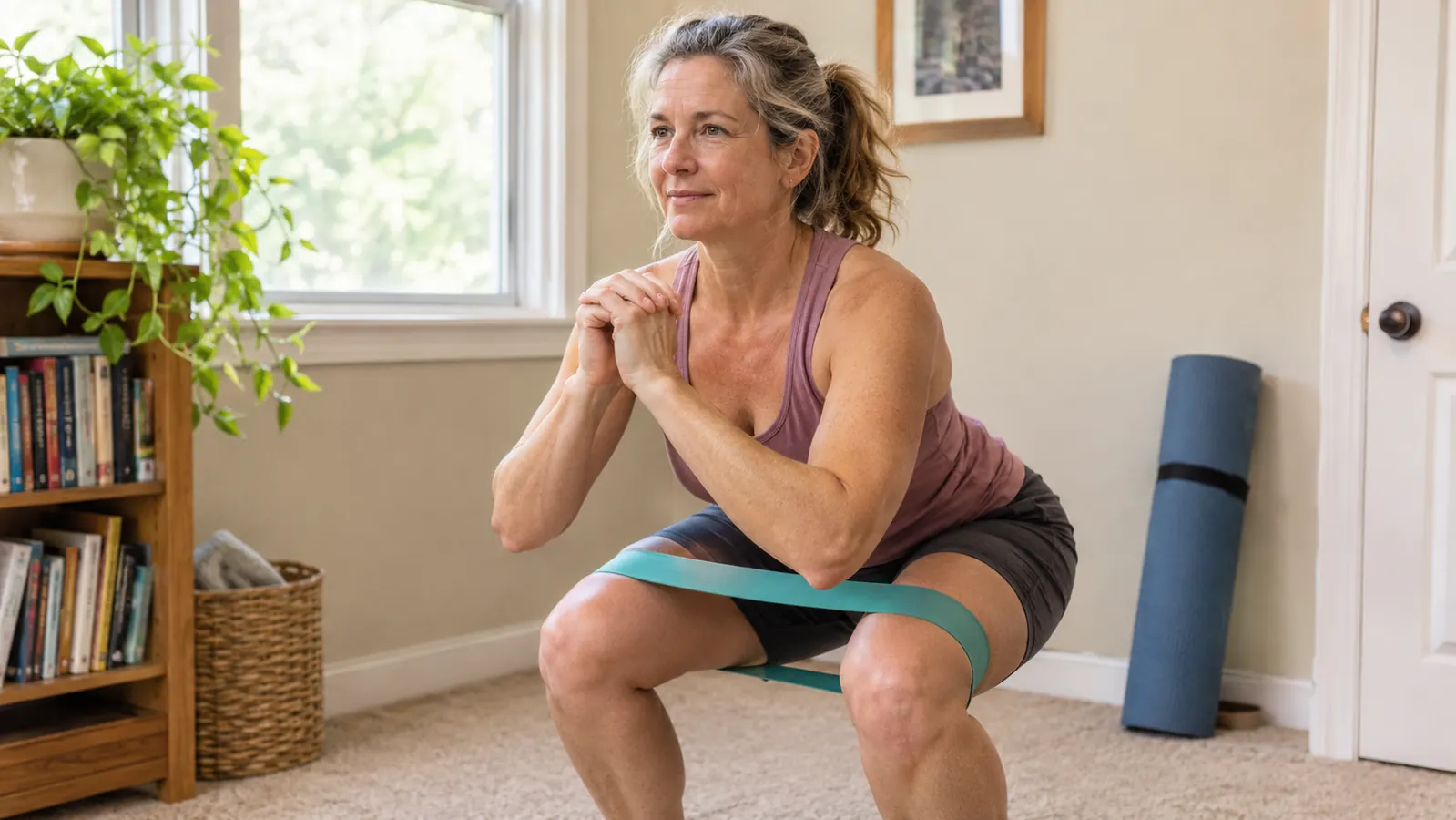
Twenty minutes is the number I keep coming back to. Not because the number is special, but because it is the amount of time I will genuinely give a workout on a Tuesday evening when the dishwasher needs emptying and Neil is asking what we are doing for dinner. I am 48. I walk most mornings with Pepper, I do short strength sessions in the spare room three or four times a week, and I go to one Pilates class on Saturdays. I am not an athlete and I have never run a marathon. I have started and abandoned more eight-week plans than I can count, and every one of them died for the same reason: it wanted forty-five minutes I did not have.
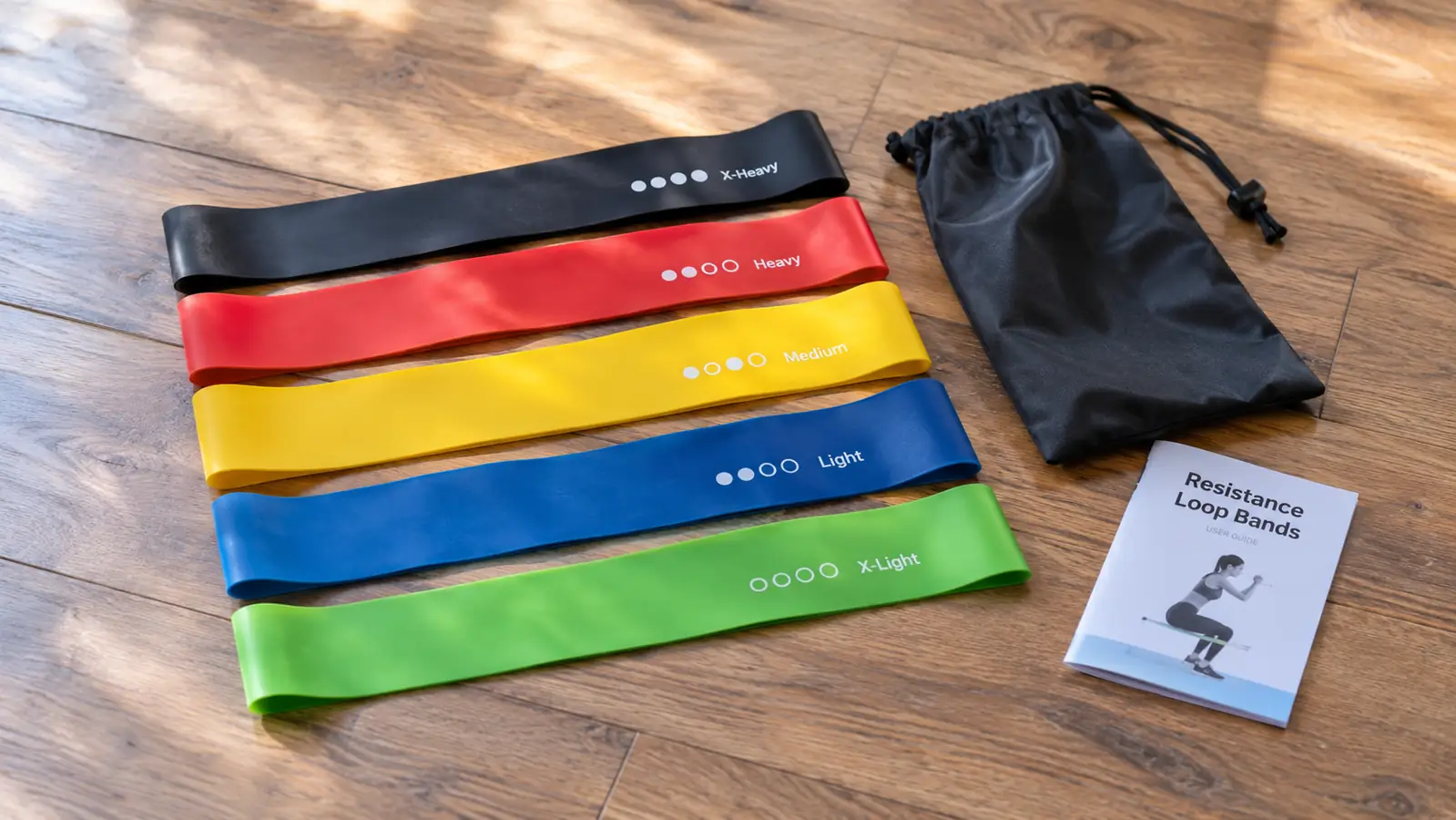
What finally stuck was a routine built around one small thing I could keep in a basket. The Fit Simplify Resistance Loop Exercise Bands are a set of five latex loops at five resistance levels, with a carry bag and an instruction booklet of illustrated exercises, and the whole set weighs 3.5 ounces. I have been using mine for about eleven months, mostly the light and medium ones. What follows is the exact twenty minutes I do, in the order I do it, and the four things I got wrong in the first month so you can skip that part.
Five latex loops, one carry bag, and a Tuesday that finally fits
The set I use: five resistance levels, an illustrated instruction booklet, and a bag small enough to live in a basket by the spare room door. No rack, no bench, no monthly fee.
Amazon Check Today's Price on Amazon →Why Twenty Minutes and Not an Hour
An hour is better than twenty minutes in theory and worse in practice, at least for me. The longer the session, the more conditions it comes with. I need to be changed. I need the spare room free. I need nobody to need anything from me for the next sixty minutes. Twenty minutes survives almost any evening. I have done it in jeans. I have done it at twenty to ten at night. That is the whole advantage, and it is not a small one.
The second reason is that a short routine is repeatable, and repetition is where the strength actually comes from. My first month I did two long sessions and felt virtuous about it. By my eleventh month I had done something closer to a hundred and thirty short ones. The hundred and thirty is the part that changed how my legs feel on the stairs. Not the two.
You also do not need a room you have to clear. I need about six feet of floor, a wall to steady myself against on the side steps, and something solid to loop a band around for the rows. That is the entire set-up, and because it stays set up, it actually happens.
The Twenty Minutes, In Order
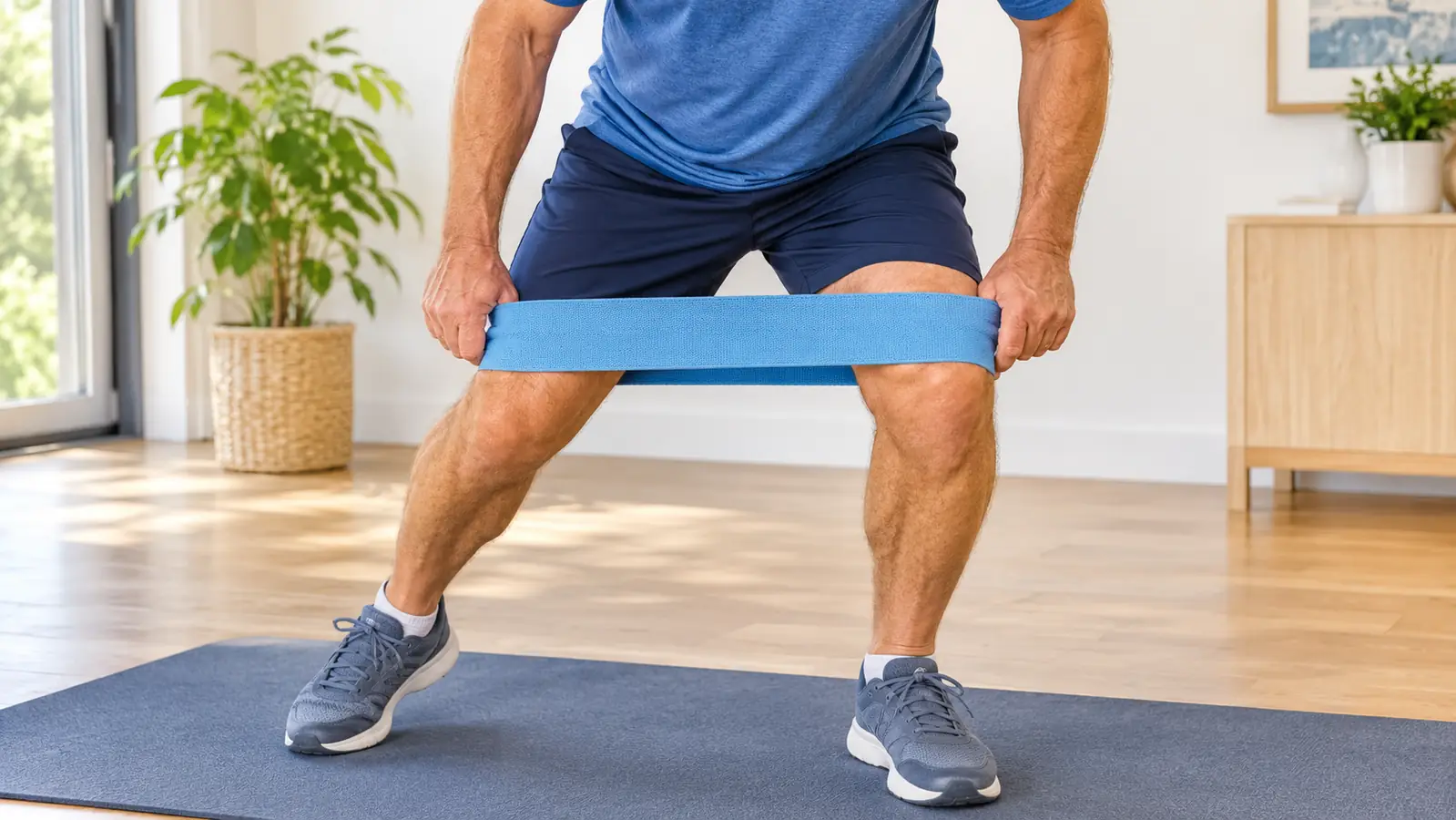
Here is the session end to end: a four-minute warm-up, two rounds of five moves at forty seconds on and twenty seconds off, then a couple of minutes of stretching. Ten minutes of that is the actual work. The rest is the part that makes the work possible.
Step 1: Choose the band you can finish every rep with
The set runs from extra light up to heavy, five bands in total, and the two lightest ones are not the beginner cop-out I assumed they were. In my first week I grabbed the heaviest band for everything, because using the heaviest one felt like the point of owning a set. I got about eleven glute bridges before my form collapsed and my lower back took over the work. That is not a strength session. That is a backache with extra steps, and it took me two days to shake off.
The rule I use now is this: if you cannot finish the last two reps of a set with the same shape you started with, the band is too heavy. For me that means the light band for clamshells and side steps, the medium for glute bridges and rows, and the heaviest only for squats, where my legs and the floor do most of the work and the band just adds tension near the top of the movement. The Fit Simplify set has enough range that I have never needed a second set to keep progressing.
Two practical notes before you spend anything. The loops are latex, so if you have a latex allergy, skip this style entirely and look at fabric loops instead. And the band has to sit above your knees without digging in. If it leaves a deep mark after thirty seconds, that is the wrong band, not the wrong exercise.
Step 2: Put the biggest movements first
Twenty minutes is short enough that order matters more than variety. I do the moves that use the most of me first, while I am fresh, and the small isolation work last. My order is squats, glute bridges, side steps, clamshells, then rows. The rows go last because they are the one thing I would quietly skip, so they sit where I cannot pretend I forgot them.
I had this backwards for about three weeks. I started with clamshells because they were easy and felt productive, and by the time I got to squats my legs had nothing left and I did six half-hearted reps before the timer ran out. Doing the hard thing first is not motivational advice and I am not going to dress it up as one. It is just the order that gets the work done.
Two rounds of five moves is ten minutes of work with the changeovers built in. That leaves roughly ten for the warm-up and the finish, which sounds generous until you notice how much better the whole thing goes when you are not starting cold. On a bad day I do one round and stop, and one round still counts. A routine you will do badly is worth more than a routine you will do perfectly twice and then abandon.
Step 3: Work in forty-second blocks and stop watching the clock
I set a timer for forty seconds of work and twenty seconds to change over, and I put the phone face down. Watching a countdown turns a short workout into a long one. Forty seconds is long enough to feel the set and short enough that I will agree to it on a day when I do not want to do anything at all.
The twenty-second changeover is the part people skip and then wonder why the session took thirty-five minutes. Move the band, get set, start on the beep. If you need a longer rest, take it, but take it deliberately rather than wandering off to check a message and coming back four minutes later.
My warm-up is unglamorous and it is always the same: marching on the spot, a few slow bodyweight squats, arm circles, and about ten side steps with the lightest band around my thighs to wake up the outside of my hips. Three or four minutes. I skipped it for the first fortnight because I thought twenty minutes had no room for it, and then I spent a week with a grumpy right hip making the argument for me.
The finish is two minutes of stretching, mostly hip flexors and hamstrings, done on the mat rather than standing about telling myself I will do it later. Then the band goes back in the bag, flat, not stuffed.
If you cannot finish the last two reps with the same shape you started with, the band is too heavy. That one line fixed more of my workouts than any plan I have downloaded.
Step 4: Anchor the band so it stays where you put it
A loop that rolls up your thigh mid-set is the most irritating thing about this style of band, and it is usually placement rather than a fault. For side steps I want the band sitting just above my knees, flat, with no twist in it. If it is on the narrowest part of my thigh, or half rolled before I even start, it will travel the whole set.
For clamshells I keep it above the knees as well and stay stacked through the hips, because if I roll back the band slides and I spend the set fighting it instead of using it. For rows I loop it around something that will not move, pull hard once to check it, and keep the band flat against the anchor so it does not bunch. Never around anything that could tip over or swing. The check takes three seconds and I have never regretted it.
The other half of the fix is how it goes back in the bag. If I peel the band off twisted and drop it in, it goes on twisted next time and then I blame the band. I lay mine flat now. Eleven months in, the Fit Simplify loops have held up well, though the lightest band has stretched a little, so it does warm-up duty rather than working duty these days.
Step 5: Progress the band, not the minutes
Around week three the temptation is to make the workout longer, because longer feels like more. I went down that road and built a thirty-five minute routine that I did four times and then stopped. What actually moved things forward was adding resistance, not time.
The rule I use now: when forty seconds of a set feels genuinely easy, not just doable, I move up one band for one of the two rounds and leave the other where it was. Two weeks of that, then the second round moves up too. It is slow and unremarkable, and it is why my squats look different now than they did in the spring.
I also keep one session a week deliberately light. Not because some programme told me to, but because my hips are 48 years old and I would rather still be doing this in November than win a Tuesday. If something hurts sharply rather than in a working way, I stop and do the move with no band at all. I am not a trainer and this is not a prescription. It is just what happens in my spare room three or four times a week.
What Else Helps
The mat matters more than I expected. Glute bridges on a bare spare-room floor made my tailbone miserable until I put a thick mat down, and the same one comes with me to Pilates on Saturdays. Beyond that I use a wall for balance on the side steps and a solid anchor for the rows, and that is the whole set-up.
The instruction booklet in the bag is more useful than I gave it credit for. It has dozens of illustrated exercises, and I used it to find the three or four moves I actually wanted rather than copying whatever came up in a video. If a move in there does not suit your body, drop it. Five moves you will repeat beat twelve you will not.
The carry bag earns its place as well. Mine has been to my sister's house and it went in a suitcase in July. A routine you can take with you is a routine that survives a week away, which is more than I can say for the plans that needed equipment I did not own.
And the unglamorous one: keep the kit where you can see it. My bag lives in a basket by the spare room door. When it lived in a drawer in the hall I did two sessions a week. Visible kit gets used and hidden kit just gets tidy.
The last thing I would say is that none of this is impressive. There is no progression chart on my wall and no before and after. What there is, eleven months on, is a Tuesday evening routine I no longer argue with, and for me that was the entire point.
Start with the light band. Everything else follows from there.
Five latex loops from extra light to heavy, an illustrated guide, and a bag that lives by the spare room door. That is the whole setup, and it is the one I kept.
Amazon Check Today's Price on Amazon →