

Every January my cheeks stage a small protest. My T-zone carries on as usual, oily and unbothered, while the skin over my cheekbones goes tight and flaky and starts to sting after about the third windy morning walk. I am 48, I have combination skin, and I spent a lot of winters buying a heavier and heavier cream, slapping it on, and wondering why my cheeks still felt rough by lunchtime.
What finally worked was not a different product. It was the order I put things in, and the fact that I stopped applying cream to a dry face. The one on my shelf is CeraVe Moisturizing Cream, the 8 ounce tube that sits next to my toothbrush in our shared bathroom. I have used it nightly for about 14 months. It is fragrance free, which matters for me because scented products make my cheeks hot and pink within minutes, and it is the same cream I use on my hands and elbows, so there is only one tube on the shelf instead of three.
One cream, two amounts, and a face that is still damp
This is the 8 ounce tube I have used nightly for over a year. Fragrance free, oil free, and it covers face, hands and elbows, which is the only reason my narrow bathroom shelf stays tidy.
Amazon Check Today's Price on Amazon →Step 1: Wash gently, and leave your face damp instead of drying it
The single biggest change for me was timing. For years I washed my face, dried it properly with a towel, then went looking for the cream. By the time I got the tube open my cheeks were already tight, and cream applied to a dry face sits on top of the skin rather than sinking in. I timed it once, out of curiosity, on a Tuesday morning in January: forty seconds between the towel and the first finger of cream, and my left cheek already felt like paper by the time I got there. Now I wash with lukewarm water and a fragrance free cleanser, pat once with the towel so my face is damp rather than dripping, and go straight for the tube. Forty seconds sounds like nothing. It was the difference between cream that disappeared into my skin and cream that sat on it in a pale film until I wiped it off on a towel.
Lukewarm matters more than people give it credit for. Hot water in a January shower feels wonderful and leaves my cheeks red and tight for a good hour afterwards. I wash my face at the sink rather than in the shower, purely because it is easier to keep the water temperature sensible when I am standing over a basin instead of steaming under a head. Our bathroom is small and shared and the hot water gets going fast, so I run the tap, wait for it to stop being cold, and use it before it gets properly hot. That sounds fussy written down. It takes about six seconds.
One warning about step one. If your cheeks are stinging rather than just dry, back off the scrubs and any exfoliating acid for a week before you start layering anything. A rich cream over freshly scrubbed skin is a reliable way to make the stinging worse. I learned that the January I introduced a new exfoliant on a Sunday, applied CeraVe Moisturizing Cream that night as usual, and spent Monday at my desk with a face that felt faintly sunburned. I blamed the cream for three weeks before I worked out the order of events.
Step 2: Warm a fingertip of cream between your hands, then press it in
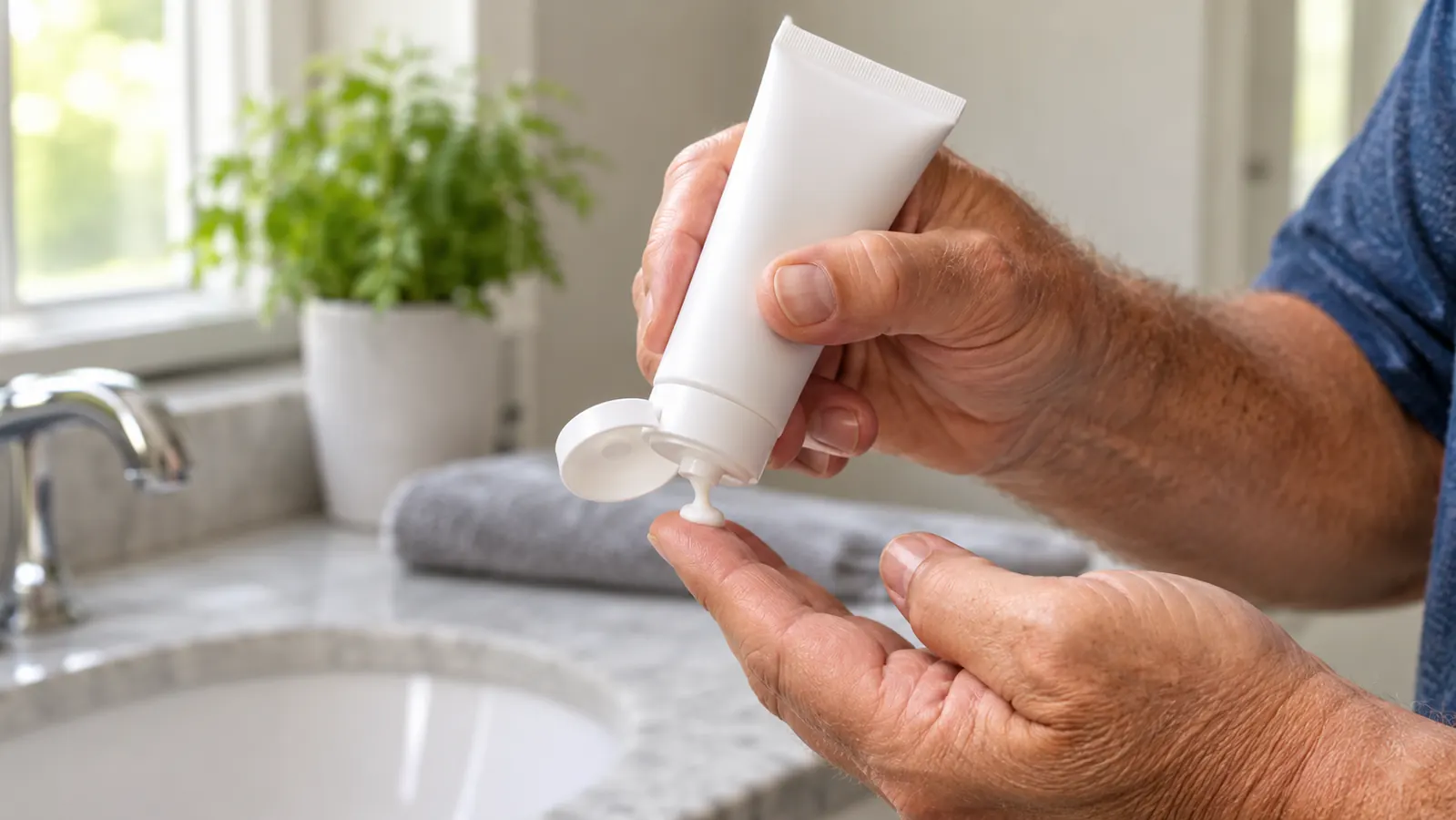
This cream is thick. Straight from the tube onto a cheek it drags, and dragging is the opposite of what irritated winter skin wants. I squeeze out a fingertip's worth, rub my fingertips together for about five seconds, and then press rather than rub, starting on the cheekbones where the dryness is worst and working outwards.
Pressing looks fussy and takes maybe twenty seconds. It also means I use less. When I rub cream in with a flat palm I get through twice as much, and half of it ends up on my jaw and neck, which never needed it. Pressing puts the product where the problem actually is. It also stops me pulling at the thin skin under my eyes, which I did for years without thinking about it.
The CeraVe formula itself is fairly plain, which is why I trust it in winter. Ceramides and hyaluronic acid, no fragrance, no oil, listed as non comedogenic and hypoallergenic, with a time release delivery technology mentioned for all day hydration. I am not a dermatologist and I cannot tell you what the ceramides are doing at a cellular level. I can tell you that it does not make my cheeks hot and pink the way scented creams do, and that has held true across 14 months of nightly use, including the stretch last February when my cheeks were at their worst.
Step 3: Use two different amounts, one for your cheeks and one for your T-zone
This is the step I resisted longest, because it feels like admin. My face is not one skin type. My nose and forehead are oily by mid afternoon even in January, while my cheeks are dry enough to flake. One amount for the whole face never worked. Enough for my cheeks was too heavy on my T-zone, and I would wake up with a shiny forehead and a small spot beside my nose.
What I do now is a fingertip amount pressed into each cheek and along the jaw, then whatever is left on my fingers goes on my forehead and nose, which is very little. In summer I use less again on the T-zone, because this cream does feel heavy there in heat. Same tube, applied differently by zone, doing two jobs. On a bad night I use roughly a pea sized amount per cheek, and on a maintenance night about half that. I know that sounds overly precise for something so ordinary, but I weighed it once on the kitchen scale out of stubbornness, and the gap between my old habit and my current one was around two and a half times as much product going onto the wrong part of my face.
If your whole face is dry rather than combination, ignore the zoning and use one generous layer everywhere. The point is not the exact amount. The point is that the dry parts get enough and the oily parts do not get more than they need. It took me a stupidly long time to accept that one product could be right for my cheeks and wrong for my nose at the same time, and that the answer was a smaller amount, not a different cream.
Enough cream for my dry cheeks was always too much for my nose. Two separate amounts, applied a minute apart, did more for me than switching to a heavier cream ever did.
Step 4: One thin layer, a one minute wait, then a second thin layer on the worst patch
When my cheeks are bad, one layer is not enough, but one thick layer feels greasy and slides around. Two thin layers with about a minute in between works better. The first sinks in. The second sits on the surface a little longer and gives the flaky patch something to hold onto overnight. The patch that always goes first is a coin sized area about an inch below the outer corner of each cheekbone, and it is the only place I bother with the second layer. The rest of my face gets one pass and is fine.
The wait is the part people skip. If I put the second layer on immediately I am really applying one big layer and smearing it around. A minute is enough for the first to stop feeling wet. I use that minute to put my hair up and set out what I need in the morning, so it is not wasted time. My husband has asked me twice why I stand at the sink doing nothing for a minute, and both times I said I was waiting for my face to dry, which is technically true and sounds ridiculous out loud.
Do not add a third layer. I tried it. It did not absorb, I ended up wiping it off on a towel, and I had used twice the product for no benefit. Two thin layers is my ceiling and I have stopped arguing with it.
Step 5: Seal it overnight, then put a different layer on top in the morning
At night the second layer is the last thing I do. Cream, then bed. That is my entire night routine and it has been for 14 months, since I bought the 8 ounce tube in November of the year before last. Here is what actually changed, in plain terms: by the fourth or fifth morning of doing this consistently, the rough patch below my cheekbone stopped catching on my fingertip when I washed my face. That is the whole measurement. I want to be clear about what it does not mean. The fine lines around my eyes look exactly as they did. Nothing was erased. What changed is texture and comfort, and I will take that.
Mornings are a different job. Cream first, then sunscreen once the cream has had a minute to settle, on my face, my neck and the backs of my hands before I take the dog out. I use Blue Lizard Sensitive Mineral SPF 50 for that step, unscented, and it genuinely needs a full minute before anything goes on over it. If you wear makeup, give the cream time to settle or everything pills. I wear mascara most weekdays and I have learned the hard way that rushing this means wiping a grey smear off my cheekbone with a tissue at 7:40 in the morning.
On the mornings I skip the cream and go straight to sunscreen, my cheeks feel tight by the time I get home. That is the whole argument for the routine, honestly. Not a transformation. Just no tightness and no flaking. The dog does not care either way, but I have noticed I touch my face less on the walk when the routine has been kept up, and touching it less means less of everything else.
What Else Helps
The cream is one variable and it is not the biggest one. Over exfoliating was, by a wide margin. I was scrubbing twice a week in winter and then wondering why the cream stung on contact. Once I dropped to once a week, and stopped entirely during the coldest stretch, the same cream stopped stinging. I want to be careful here, because it is easy to read that as the product being weak. It is not. It is that no moisturizer applied to skin you have just scrubbed raw is going to feel like anything but a sting. If your cheeks burn when you apply moisturizer, the moisturizer is usually not the culprit. The scrub is.
Water temperature and time in the shower come second. Ten minutes of hot water on my face does more damage than a missed night of cream. I wash my face at the sink with lukewarm water and keep the hot shower for my shoulders, which do not complain. There is also a cheap thing worth trying: change your pillowcase more often than feels necessary. I do mine twice a week in winter and I cannot prove it did anything, but it costs nothing and it takes less time than the rest of this routine.
A humidifier in the bedroom helped a little in the two weeks a year when Concord actually gets cold and dry. Not a dramatic difference, and I would not buy one for this alone, but it is a cheap thing to try if your cheeks are worse in the morning than they are at night. Drinking more water did nothing visible for my skin, whatever anyone tells you.
And if your cheeks are cracked, bleeding or hot to the touch rather than simply dry and tight, that is a conversation for a doctor, not a layering problem. I am not a dermatologist. This is what worked for one 48 year old with combination skin through a California winter, not a treatment plan.
If your cheeks sting by the second week of January, start here
Wash lukewarm, pat once, press a fingertip of cream into each cheek while the skin is still damp, wait a minute, then add a second thin layer on the worst patch. That is the whole routine, and one tube covers your face, hands and elbows.
Amazon Check Today's Price on Amazon →